
Savannah Directory Collections by Era
Savannah’s published inventory begins with business directories in 1848 and 1849, followed by resident coverage in 1850. The official City guide lists later books with gaps. No single access point has every issue. The Savannah City Directories Guide is the year-by-year control, while the repositories below provide complementary digital and physical runs.
| Collection | Years | Where Held | Access |
|---|---|---|---|
| Business and resident volumes | 1848 onward, with gaps | Bull Street Library, Kaye Kole Room | Microfilm, microfiche, books, and library databases |
| Free scanned volumes | 1871 through 1959 | Digital Library of Georgia | Free online scans |
| Long repository run | Most years, 1848-2001 | Georgia Historical Society | Hardcopy or microfiche under research-center rules |
| Householder and street guide | Verified in Polk 1954 | Directory volume | Pink-paper reverse section with intersections and phones |
Many volumes from 1866 forward can also be reached through Ancestry at a subscribing library. Titles and publishers changed often, so cite the title page rather than assigning a run from memory. The Georgia Historical Society’s statement of most years through 2001 is safer than claiming every year survives. Savannah’s 1919 preface also says the city did not miss its 1917 wartime edition, even as other Georgia cities did.
Search Savannah Directories Online
The Digital Library of Georgia collection provides free scanned Savannah books from 1871 through 1959. Publishers represented include T. M. Haddock, J. H. Estill, A. E. Sholes, H. A. Goette, Luke P. Pettus, and R. L. Polk & Co. Examples include Haddock in 1871, Estill in 1874-75, Sholes around 1879-80 and 1900, Goette in 1901-03 and 1905-08, Pettus in several 1920s issues, and Polk in 1954.
Search OCR for a surname, but always open the scanned page. Old type and short forms produce bad text matches. The 1874-75 entry for Peter Asendorf, for example, identifies him as a clerk boarding at 93 Price. John Asendorf’s entry links a grocery and saloon at that address with his residence there. Those details are visible only when the abbreviation and page layout are read together.
The City’s published research guides route directory finds into building, genealogy, neighborhood, newspaper, employee, port, railroad, and African American collections.
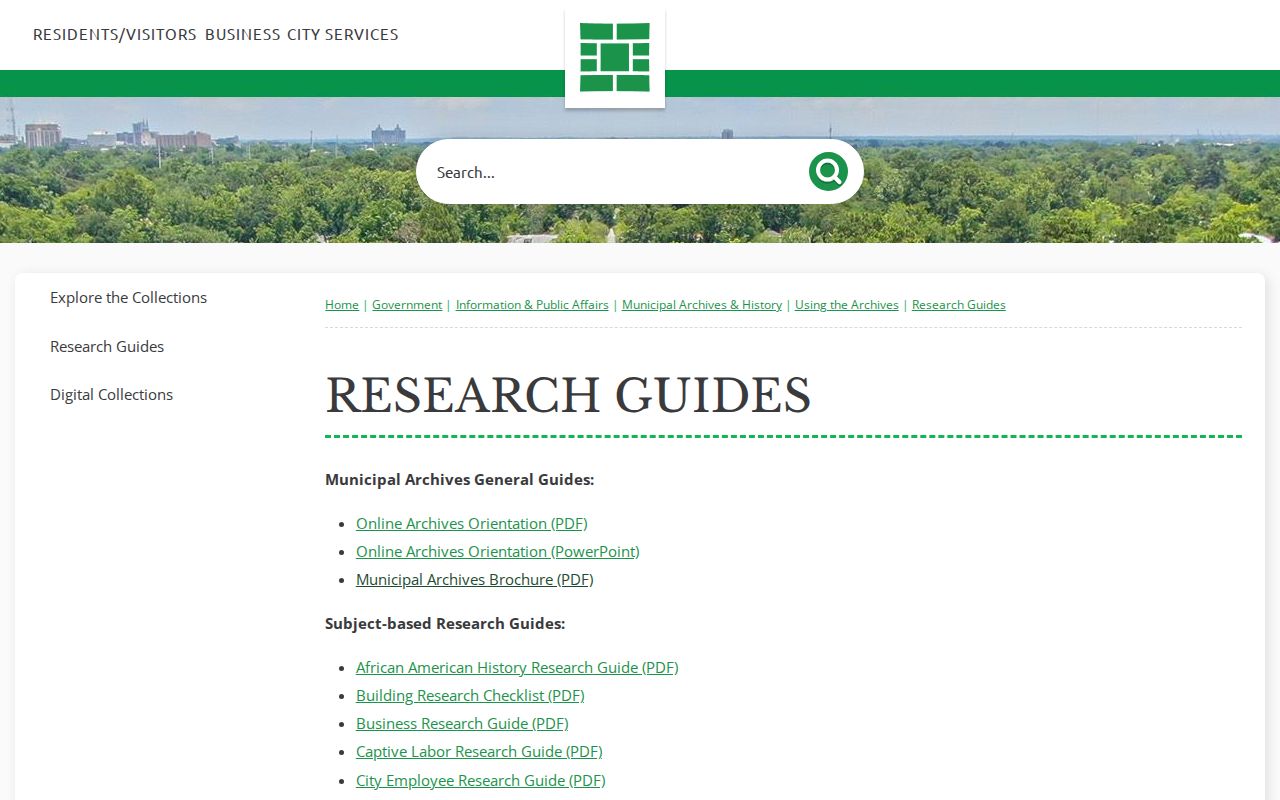
The guide screen helps choose a record series after a directory supplies a name, address, or trade.
Savannah Directory Help at Bull Street
The Bull Street Library’s Kaye Kole Room holds directories, microfilm, genealogy databases, and newspapers. Call 912-652-3697 to confirm a year and current access before visiting. Staff can help identify the right format, but a researcher should arrive with a surname, rough year, and known street. The City guide uses repository symbols to show where each issue is held.
For deeper work, the Georgia Historical Society Research Center reports hardcopy or microfiche for most years from 1848 through 2001. Its catalog, appointment, and reproduction rules apply. That long run helps fill holes left by a digital shelf without implying that every annual book exists.
The research-center page leads to the catalog and current rules for consulting the physical Savannah run.
Note: Photograph or transcribe the volume title, year, publisher, page, and abbreviation key before moving to the next issue.
Savannah Directory Publishing Timeline
The changing imprints explain why search interfaces and book layouts vary. Use these dated landmarks as finding aids, not as claims of unbroken publication.
| 1848-49 | Earliest repository-listed Savannah business directories |
|---|---|
| 1850 | Resident directory coverage appears |
| 1871 | T. M. Haddock volume in the digitized run |
| 1900 | A. E. Sholes volume claims 28,213 names |
| 1919 | Preface recalls uninterrupted wartime publication |
| 1954 | Polk volume includes a householder and street guide |
The 1900 publisher split its reported names into the racial categories used in that period: 15,933 White and 12,280 under the book’s historical “colored” label. Preserve that context when citing the number. It describes a publisher’s count and classification, not a modern census.
Read a Savannah Directory Entry
A city directory entry is compact. The alphabetic section usually starts with a surname and given name, then adds short forms for work, residence, or boarding. Later issues may put a spouse in parentheses. Widow notation can name a deceased spouse. Occupation and employer are especially useful for separating two Savannah residents with the same name.
| Name | Usually alphabetized by surname, with head-of-household bias |
|---|---|
| Work | Occupation and sometimes employer or business address |
| Address | Street form current in that publication year |
| Spouse or widow | Parenthetical spouse or “wid” plus a deceased spouse’s name |
| Street position | Side and distance from a cross street in some early books |
- Criss-cross directory
- A reverse section arranged by street and house number instead of surname.
- Householder index
- A street-order list of named householders, sometimes with phone or owner marks.
- Abbreviation key
- The volume’s own list of short forms, which controls how that issue should be read.
In the 1874-75 issue, clk means clerk, bds means boards, and r means residence. Side codes such as ss and direction codes such as e describe a location from a cross street. OCR can mistake clk for “elk,” so the scan controls.
Reverse a Savannah Street Index
The street section lets an address lead to a listed occupant or business. Search the street name, locate the nearest cross street, and read the house numbers in sequence. Then return to the alphabetic pages for the same name. This two-way check catches OCR errors and helps tell a work address from a residence.
Savannah’s 1910 guide explains that numbering ran north and south from Bay Street and east and west from Bull Street, at roughly 100 numbers per block. Even numbers were generally on north and east sides, with odd numbers on south and west sides. That rule is a clue, not a substitute for the printed entry or a map.
For a present-day address and parcel workflow, use the Savannah street directory search. Historical books should remain the main source for past occupants.
Bridge Savannah Directory Gaps
Savannah’s municipal archive preserves parallel people records. Tax digests cover 1809-1903, voter registers 1856-1917, death registers 1803-1853, births 1889-1896, and combined vital registers from 1898 into 1919. Burial records include interment reports from 1852-1903 and Bonaventure lot records from 1850-1958. These sets can test an identity when a directory year is missing.
The Municipal Archives collection inventory links finding aids and selected digital partners. Originals may require an appointment at City Hall. Remote questions are accepted, and the finding aids should be searched by record series before asking staff for a box.
Savannah Funeral Programs Add Kin
More than 400 funeral programs, mainly for twentieth-century African American Savannah residents, are available through the City’s Digital Collections. A program can name relatives, church ties, burial place, schools, work, and major life events. It supplies detail that a one-line city directory entry cannot hold.
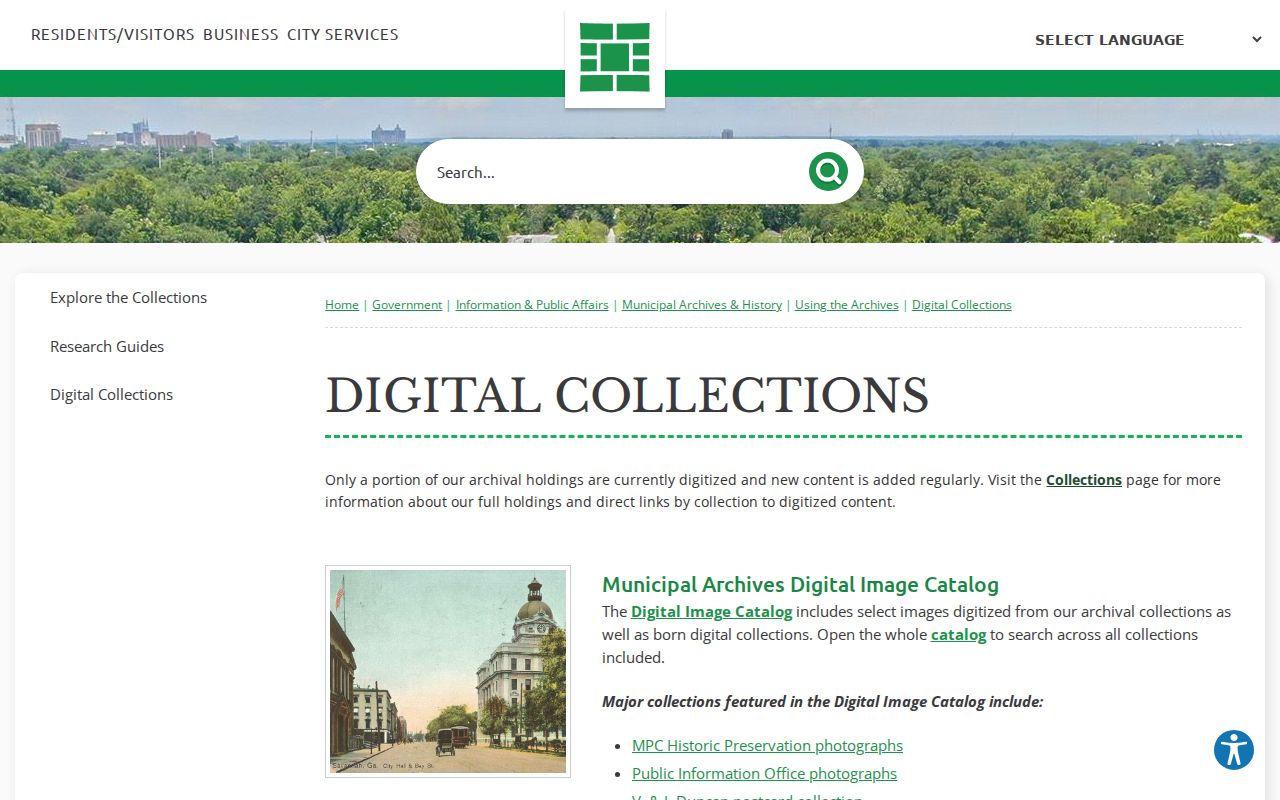
The portal groups the contextual collections that can extend a brief directory entry into a researched family connection.
Funeral programs are contextual sources, not official occupancy rolls. Check their claims against cemetery registers, obituaries, probate, directories, and vital records where access rules permit. Savannah’s W. W. Law and NAACP collections also add civic-network context, while historical racial sections and designators in commercial directories should be handled with care.
Trace Family in Savannah Directories
Use city directories as annual checkpoints between public census years. Begin with the best known date and copy the entry as printed. Move one issue at a time, because a changed address, spouse note, or employer can separate people with similar names. Federal census schedules are public through 1950 under the 72-year release rule.
- Find the person in the alphabetic pages and record every short form exactly.
- Check the street index for the address and nearby listed names.
- Move forward and backward by year, noting a move, widow mark, new occupation, or disappearance.
- Compare the 1880, 1900 through 1940, or 1950 census where the dates fit.
- Use tax, deed, obituary, probate, burial, or funeral-program evidence to explain the change.
A gap can mean a move, death, missed canvass, altered name, annexation, or simple omission. Children and many women may be absent because older books favored heads of household. Do not treat one missing entry as proof of an event. A two-source match based on name, address, spouse, occupation, or kin is much stronger.
Note: When a name disappears, check the next year’s street entry before assuming that the whole household left Savannah.