
Walk a Savannah Street Record
A current address can lead to an owner, but it does not produce a full list of people who live there. Chatham County’s assessor identifies the titled owner and keeps the mailing address apart from the situs, or physical property address. SAGIS adds the parcel shape and nearby lots. Deeds then document transfers between named parties. A voter file or a city directory can add residence evidence within its own limits. Keep each claim tied to its source and date.
- Standardize the delivery address, including its direction. Search the Chatham County assessor and save the PIN, owner, situs address, mailing address, legal description, and sale book and page.
- Open SAGIS and search the address without the street suffix, such as
110 E State. Click along the street and compare adjacent parcel labels. - Use the owner and book/page in the GSCCCA index. Confirm the same legal description before connecting a deed to the parcel.
- For lawful voter research, use an authorized voter-list request. My Voter Page is only an authenticated self-lookup, not a public street browser.
- For an older household, check the street section of a Savannah directory, then verify the name in its alphabetic section.
This order makes the Savannah street directory useful without turning an owner roll into a claim about every resident. It also preserves enough detail to continue at a public terminal when the web index ends.
Savannah Address Search Fields
The Chatham County Board of Assessors Records Search is the first official stop for a modern parcel. It is free and GIS enhanced. Search by one strong field, then use the returned PIN to avoid confusing similar street numbers or owner names. The result can show values, acreage, tax district, sale dates, book/page references, building traits, and homestead flags. A homestead flag may support owner occupancy, but it is not a list of all occupants.
| Search control | Input | When to use it |
|---|---|---|
| Owner name | Surname, person, or entity | Find parcels tied to a known owner |
| Property address | Number and street | Find the physical Savannah site |
| Parcel or PIN | Exact identifier | Return to one confirmed parcel |
| Legal or subdivision | Advanced criteria | Separate lots in a shared street name |
Read the owner mailing address and situs address as two separate facts. The first tells the county where to send notice. The second locates the land. Their mismatch is common and does not establish where the owner lives.
Browse Savannah Streets in SAGIS
The SAGIS Map Viewer turns one parcel result into a street-by-street inspection. Its parcel search supports property address, owner, PIN, and a drawn area. Entering only a street, such as E State, can return parcels along it. The viewer’s Search, Identify by Query, layer, historic imagery, and Near Me tools add context. Right-click options may produce a property report, mailing labels, or a street view.
Useful Savannah layers include parcels, owner and address labels, building footprints, wards, neighborhoods, annexations, the municipal boundary, ZIP codes, zoning, historic districts, and flood areas. Shift selection can group several lots, while exports can preserve selected results. Treat the map as an index, not a survey. SAGIS itself warns that deeds and plats control legal boundaries.
Note: Save the PIN and legal description before moving to the next lot, since map labels can change while recorded land descriptions persist.
Savannah Ward Lots Preserve Identity
Downtown Savannah property often carries a ward and lot description. That local geography can remain stable when a house number, street label, or postal form changes. A reliable street directory search compares the ward, lot, cross streets, Sanborn sheet, directory street index, and the deed’s legal description. The City’s engineering records also include a Private Property Surveys Index divided by ward-name ranges.
- Parcel
- A mapped tract used for assessment and assigned a PIN.
- Situs address
- The physical location of the parcel, distinct from the owner’s mailing address.
- Plat
- A recorded drawing that shows lots, blocks, boundaries, and subdivision details.
- Criss-cross directory
- A directory section ordered by street and number rather than by surname.
This geography is especially useful for family and house history. Savannah’s ward plan reaches back much farther than modern parcel databases, so it can bridge a current address to tax, survey, map, and deed records.
Savannah Records Indexed by Address
No one file is a complete Savannah street directory. The best result chains sources that answer different questions. The parcel roll identifies ownership, SAGIS establishes place, the deed index documents transfer, permits date work, and historical directories name listed occupants. Voter material has separate access and use rules.
| Record Set | Keeper | What It Shows | Access |
|---|---|---|---|
| Property record | Chatham Board of Assessors | Owner, mailing and situs addresses, PIN, sale references | Free online search |
| GIS parcel map | SAGIS | Lots along a street, boundaries, wards, zoning, footprints | Free interactive viewer |
| Deeds and plats | Superior Court Clerk and GSCCCA | Named parties, recording date, book/page, legal description | Web index and courthouse terminals |
| Voter records | Secretary of State and county registrar | Permitted public voter fields, with protected data withheld | Formal order, legal limits apply |
| Building permits | Savannah Development Services | Project address, applicant or owner, contractor, work dates | Online from July 30, 2016; older records by request |
The PIN ties the assessor and map together. Book/page links the parcel card to a recorded instrument. An address can then lead to permits or a directory entry, but each source must retain its date. This chain distinguishes a current title holder from a person listed at that site years ago.
Follow Savannah Deeds by Street
The GSCCCA Real Estate Index supports name, county, book/page, instrument, and property-based modes. Select Chatham County. A result may show grantor and grantee roles, instrument type, recording date, book/page, property terms, and links to images when access permits. Grantor means the party transferring an interest; grantee means the party receiving it.
Statewide standardized index coverage is assured since at least January 1, 1999. Earlier Chatham books and indexes remain at the Clerk’s record room. The Real Estate Division instructions describe public computers at 133 Montgomery Street, Room 304, weekdays from 8 to 5, plus a Southside copy location and mail requests. In-office searching is free. Existing deed copies are listed at 50 cents per page, while certification costs extra.
The Clerk helps with access but does not conduct title research. Search each seller as an earlier buyer, and compare the legal description at each step. The resulting owner chain belongs in a Savannah street directory only as ownership evidence.
Savannah Deed Index Screen
The official real-estate index guide shows how Georgia organizes its deed search modes and results.
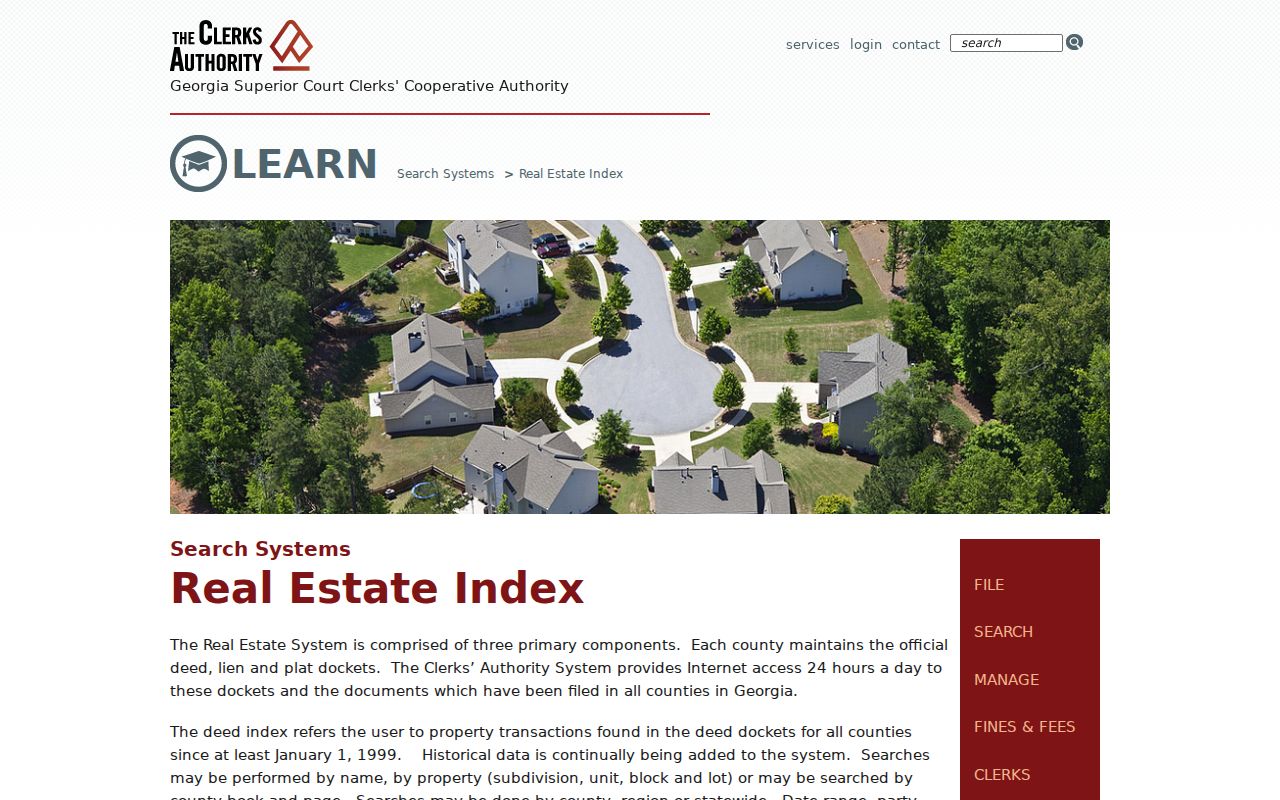
The screen supports the move from an assessor book/page reference to a Chatham instrument. Record the county, roles, date, instrument type, and legal terms before paying for an image.
The Chatham real-estate records FAQ explains the local terminal, copy, and request options.
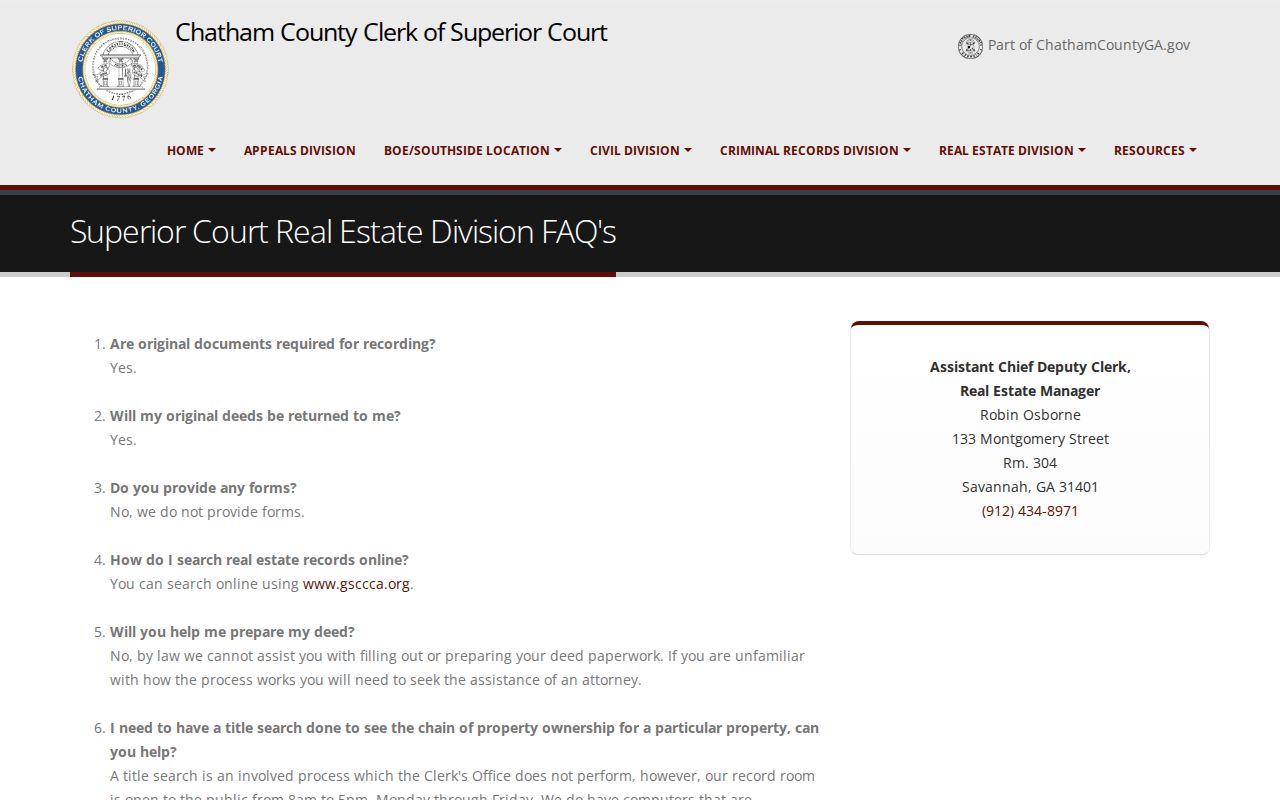
This local page is the bridge from the statewide search to courthouse inspection and selected official copies.
Savannah Permit Evidence by Address
City permit records add a building timeline. Savannah publishes commercial and residential application records online from July 30, 2016 forward. Older permits, plans, and demolition worksheets require Development Services, the City open-records route, or Municipal Archives. Include the address, date range, permit number, and parcel PIN when known.
A permit may name an applicant, owner, contractor, project address, and work dates. It establishes work, not occupancy. Archival runs reach deeper: permit indexes cover 1897-1908, building permits 1899-1937, and Council permits 1909-1941. Several of those series can be searched by street or ward.
Note: A remodel date may explain a changed footprint or unit count, but it does not prove who lived there at the time.
Reverse Savannah’s Historic Streets
Savannah directories generally include resident, business, and street sections. The street index reverses the usual surname search. It groups entries by street and nearest cross street, which makes it a strong source when only an old address is known. Mid-century proof is clear in Polk’s 1954 pink-paper householder and street guide, which printed intersections, telephone numbers, and owner marks.
Search the street section first, then confirm a listed person in the alphabetic section. Historical abbreviations and racial publishing practices require care. The full shelf and its publication history belong to the Savannah city directory collection, while this by-address use stays focused on one street.
Savannah Voter Records Have Limits
Georgia My Voter Page asks for first initial, last name, county, and date of birth. It returns the authenticated voter’s status, polling place, districts, sample ballot, and participation history. It is not a public browse-by-street tool. A full voter list follows a separate Secretary of State or county ordering process under Georgia election law.
Permitted public fields can include residence address, mailing address, registration date, status, and participation history. Social Security numbers, state identification numbers, full birth dates, contact details, and VoteSafe-protected addresses are withheld or restricted. A registered voter list also omits nonvoters and never proves a complete household.
Savannah Street Directory Boundaries
A street search cannot lawfully reveal a complete private household. Chatham parcel records are owner based. Deeds concern property interests. Voter files cover registered voters under specific access rules. Directories reflect only the people and businesses selected for publication. Renters, children, other household members, protected residents, and people who opted out of a publication can be absent.
Driver address data is restricted by federal and state law. Utility customer accounts are not a general public resident list. Safe at Home and VoteSafe protect qualifying addresses through different state programs. Absence from any one source is not proof that a person did not live at a Savannah address.
Lawful use. Use Savannah address records only for lawful personal research, such as family or property history. Never use them to stalk, harass, threaten, or harm a person.